August 21, 2026
If you're a colorist, you probably already know the value of having proper scopes beside your grading interface. The challenge has often been getting a live 4K signal into your computer without spending too much on dedicated I/O hardware.
Until now, many colorists looking to use Nobe OmniScope with a 4K SDI workflow considered devices such as the UltraStudio 4K Mini and similar solutions. While being powerful, they also cost around €1,119 / $1,229; making the capture hardware more expensive than the software scopes themselves.
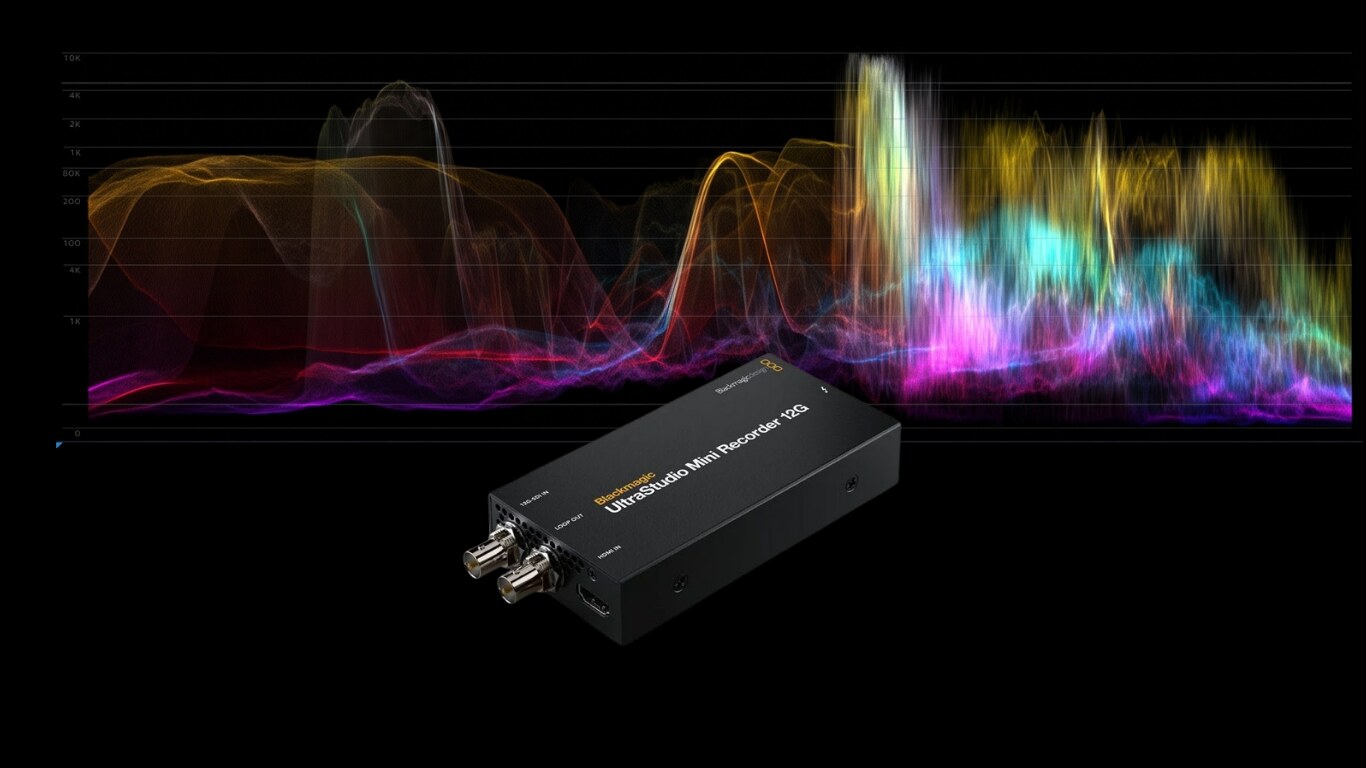
Now the new Blackmagic UltraStudio Mini Recorder 12G comes in at €415 / $445. Paired with Nobe OmniScope, it offers a much more accessible way to bring an Ultra HD signal into your computer while giving you all the benefits of professional software scopes.
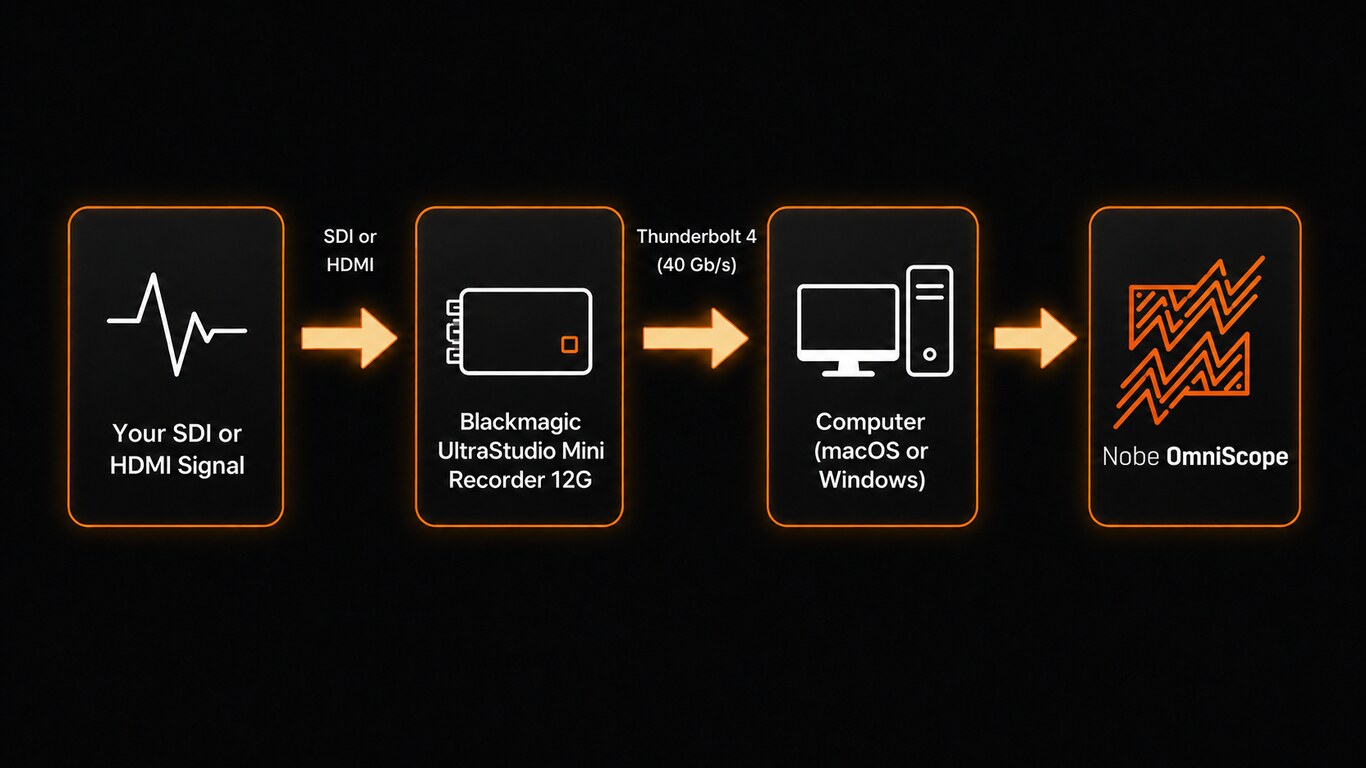
The setup is simple: your SDI or HDMI signal goes into the Mini Recorder 12G, the Mini Recorder connects to your computer over a single Thunderbolt 4 cable, and OmniScope picks the signal up as an input source.
The Mini Recorder 12G supports 12G-SDI and HDMI 2.0 input in SD, HD and Ultra HD, giving you the flexibility to work with the signals you're already dealing with in your grading workflow. SDI rates run from 270Mb all the way to 12G, so everything up to 2160p60 arrives over a single BNC.
Where it gets interesting is the signal quality, because on that front it gives up almost nothing to the far more expensive box. Both the Mini Recorder 12G and the UltraStudio 4K Mini capture 8, 10 and 12-bit RGB 4:4:4 up to 2160p30, and 8 and 10-bit YUV 4:2:2 in all standards. Both cover Rec.601, Rec.709 and Rec.2020, and both handle HDR static metadata with HLG and PQ transfer characteristics. For scope work, that is the part that actually matters: you are analyzing the same pixels either way. Note that 12-bit Blackmagic input is an OmniScope Pro feature; 10-bit works on every license tier.
What the 4K Mini adds is everything a dedicated scope machine never touches: SDI and HDMI outputs, analog video and audio connections, and 3D dual-stream modes. If the box only ever needs to get a signal in, you are paying roughly a third of the price for the same capture precision.
One practical note: the Mini Recorder 12G connects over Thunderbolt 4, which carries both video and power down one cable. Blackmagic lists it as working with Apple Silicon Macs and Thunderbolt 4 or Thunderbolt 5 PCs, so Intel Macs are not supported.
Once the signal is in OmniScope, you can use your scopes to really dig into the image; whether you're checking exposure, balancing color, looking at saturation or making sure nothing is getting pushed where it shouldn't.
We've spoken to users who wanted to add OmniScope to their workflow but couldn't justify the price of the hardware required to support a 4K signal. The introduction of the UltraStudio Mini Recorder 12G creates a much lower price, making a dedicated software scope setup far more accessible.
Rather than investing in a larger I/O device with features you may not need, you can now use a compact capture device focused on one job: getting the signal into your machine so OmniScope can do the analysis.
If you're a colorist looking for a straightforward way to get an SDI or HDMI signal into OmniScope, the UltraStudio Mini Recorder 12G is an interesting new option.
Connect your signal, open OmniScope, and get your scopes right there beside your grading workflow.

